Branded Podcasts: What Makes Them Unique and How to Leverage Them for Your Brand
Branded podcasts are a powerful way to combine subtle brand communication with genuinely engaging content. But when does a branded podcast actually make sense? What does it take to make one successful? And what should you keep in mind before getting started? In this article, you’ll find everythin…
)
Reading progress
In this article
In this article
Key Facts: Branded Podcasts
Definition: A branded podcast is produced by a company to build brand image, trust, and long-term brand loyalty, without relying on overt advertising.
Benefits: It stands out through authenticity and a sense of closeness, strengthens positive brand perception over time, reaches target audiences directly, and serves as a valuable addition to both marketing and SEO efforts.
Costs: Costs vary depending on setup, production complexity, software, and marketing. Simple formats often range from $250 to $600 per episode, while more sophisticated productions can easily reach four-figure budgets.
Recording: You can record conversations with guests without a studio, for example right in the browser with the Podigee Recording Studio. The recording becomes your episode directly.
Success Factors: A branded podcast is most likely to succeed when it has a clearly defined target audience, delivers relevant, engaging, and authentic content, is published consistently, and is continuously optimized based on performance KPIs.
Podcast software: With an open podcast platform like Podigee, you have recording, hosting, video, transcription, analytics, and monetization in one place, GDPR compliant and hosted in Germany and the EU.
What Is a Branded Podcast?
A branded podcast (also referred to as a sponsored podcast) is a podcast that is either commissioned or produced by a brand or company to communicate its values, identity, and key messages. Rather than focusing on direct product promotion, the goal is to provide real value to the audience through storytelling, educational content, interviews, discussions, or entertainment.
Unlike traditional advertising formats, a branded podcast is designed to build a long-term relationship with listeners, foster trust, and position the brand as authentic, relevant, and credible. Brand messages are typically woven in subtly and indirectly, through topics that align with the company’s mission and values.
Branded Podcast vs. Corporate Podcast: What’s the Difference?
The terms are often used interchangeably, but there are subtle differences:
Corporate Podcasts tend to be more formal and are often used for internal communication (e.g., for employees) or for B2B positioning.
Branded Podcasts are typically more consumer-facing and focus on storytelling, entertainment, or lifestyle content to build emotional connections and brand affinity.
How Are Branded Podcasts Structured?
Branded podcasts can take many different forms. What matters most is that listeners can clearly recognize that the podcast is created by a brand or company. This is typically achieved through elements such as incorporating the brand’s logo into the cover artwork and including a short intro message at the beginning of each episode.
Beyond that, there are no limits to your creativity.
New to podcasting? Our step-by-step guide to starting a podcast walks you through everything you need to know to launch your own show successfully.
Why Branded Podcasts Are a Game Changer
There are several reasons why branded podcasts are gaining momentum:
Undivided Attention: While users often scroll past ads within seconds, podcast listeners typically stay engaged for 20, 30, or even 60 minutes.
Emotional Connection: The human voice creates a sense of intimacy and trust. Over time, listeners can develop a genuine connection with the host.
Low Resistance: Because the content provides real value, it doesn’t feel like advertising. Listeners actively choose to tune in.
Precise Targeting: Podcasts allow you to reach highly specific audiences that can be difficult to access through traditional channels.
How Much Does a Branded Podcast Cost?
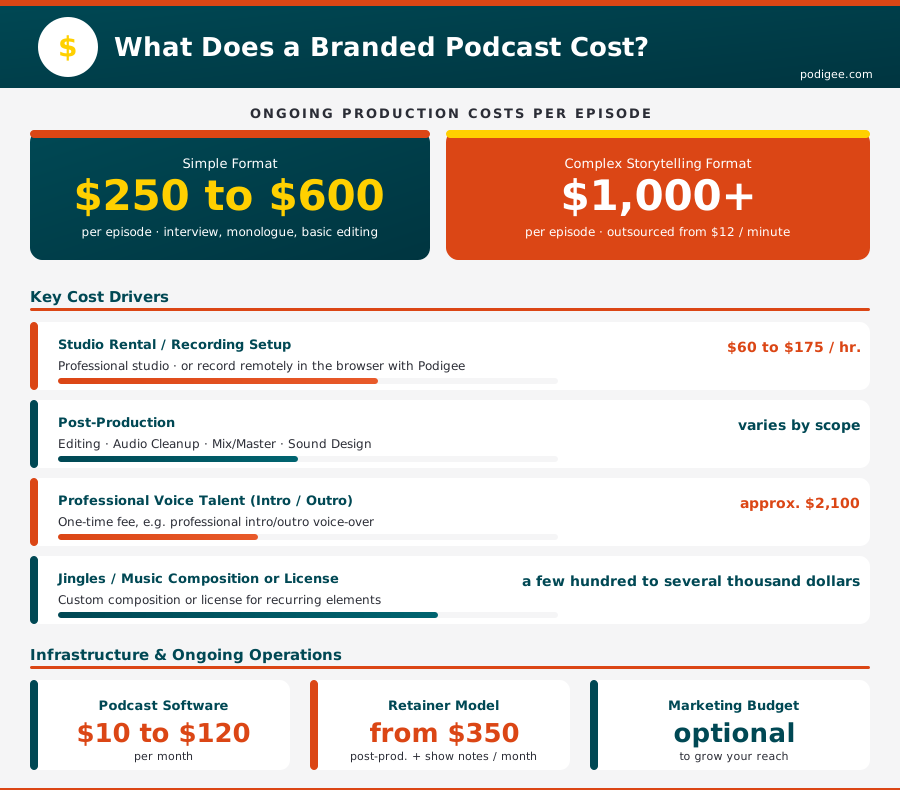
There’s no single answer to how much a branded podcast costs. Expenses depend on a wide range of factors, from studio time and technical equipment to guest fees, music licensing, production costs for jingles, podcast software, and your overall marketing budget.
That’s why it’s common practice to estimate costs per episode while also accounting for one-time setup expenses.
For ongoing production, simple formats typically range from around $250 to $600 per episode. More elaborate storytelling formats can easily reach four-figure budgets per episode. If you outsource production, pricing is often calculated per finished minute of audio, with rates starting at around $12 per minute.
One of the biggest cost drivers is the recording setup. Professional studio time usually costs between $60 and $175 per hour. For interviews and panel conversations, there is often a more affordable option: recording remotely in the browser, for example in the Podigee Recording Studio, saves you studio rent and travel. You’ll find more on this below. On top of that, you’ll need to budget for post-production (editing, sound design, mixing, and mastering), as well as recurring elements like intro and outro production.
For brand-specific elements, companies often commission custom jingles or original compositions, which can range from a few hundred to several thousand dollars. Alternatively, you might opt for licensed music or hire a professional voice actor for your intro and outro. Costs for this can also be significant, with examples around $2,100 for a professional voiceover.
In addition to production, there are ongoing infrastructure and operational costs, such as podcast software (typically between $10 and $120 per month, depending on features; here you can compare all Podigee plans and prices). Many companies also underestimate the ongoing workload behind a podcast: project management, publishing, writing show notes, creating assets, distribution, and reporting all require time and resources.
Some service providers offer retainer models to cover these tasks, for example post-production including show notes and publishing starting at around $350 per month.
Podcast software can take some of this routine off your plate: Podigee creates transcripts and show notes drafts automatically, suggests chapter markers, and turns every episode into drafts for LinkedIn posts, newsletters, and short clips. That leaves more time for your content.
Overall, a realistic budget for a branded podcast usually combines one-time setup costs with recurring per-episode expenses, plus an optional marketing budget to help grow your audience over time.
Our overview of podcast software and tools shows you which tools you actually need and how to make your podcast workflow easier.
How Do You Record a Branded Podcast?
Many branded podcasts are built on conversations: with experts, customers, or colleagues from other locations. You don’t necessarily need a studio for that. With the Podigee Recording Studio (from the Grow plan), you record right in the browser with up to eight people and for up to four hours per session. Your guests join via an invitation and don’t need to install anything.
Each person is recorded on their own device, so every voice gets its own track in full quality, even if the internet connection wavers. If the cameras are on, Podigee automatically puts together a combined video. In the editor, you trim the tracks, and the recording becomes your episode directly, with no export and no re-upload.
➔ How the Podigee Recording Studio works for remote recordings with guests
How Does Hosting Work for Branded Podcasts?
Hosting a branded podcast works technically in much the same way as hosting a “traditional” podcast. However, there are additional strategic and organizational considerations, since a company is behind the production. In this section, we’ll walk you through what matters most when hosting a branded podcast.
It’s worth noting that you can publish a podcast without any podcast software. However, this requires significant technical expertise, as well as considerable time and financial resources, and it can be prone to errors.
Podigee is the open podcast software for businesses, from recording to reporting: recording, hosting, video, transcription, analytics, and monetization all run through one account. Learn more about podcast hosting and distribution with Podigee. That way, you can focus on your content while the technical side is taken care of.
Podcast Hosting: The Basics
Whether you’re running a traditional or a branded podcast, the basic workflow is the same once an episode is finished:
Upload: Your audio or video files are uploaded to your podcast software. If you record directly in Podigee, you can skip this step, because the recording is already there.
Processing: The podcast software stores your files and generates an RSS feed, a machine-readable file hosted at a stable URL.
Distribution: This RSS feed is submitted to platforms like Spotify, Apple Podcasts, or Podimo, making your podcast available to listeners. Podigee also distributes video episodes to YouTube, Spotify, and Apple Podcasts.
Analytics: Based on how your audience listens to and interacts with your podcast, your podcast software offers detailed analytics to help you understand performance.
Hosting a Branded Podcast: What to Consider
Because a branded podcast is owned by a company, there are a few additional factors to keep in mind:
Ownership & Control
Your company should retain ownership of the RSS feed and all platform accounts, even if you work with an external agency. This ensures long-term control over your data and brand presence.➔ In Podigee, you assign roles and permissions per podcast. Agencies and colleagues get exactly the access they need, and the feed stays in your hands. If you move from another provider, your subscribers and ratings carry over via redirect. Learn how hosting, distribution, and switching providers work with Podigee.
Tracking & Analytics
Branded podcasts require reliable, ideally IAB-compliant analytics and advanced tracking capabilities. This allows you to measure reach, evaluate campaigns, and align performance with your marketing goals.➔ Podigee measures to the IAB 2.2 standard and can email you a weekly report. You can also ask about your numbers in Claude or ChatGPT, for example for your next quarterly report, with the Podigee MCP Server for podcast analytics in Claude and ChatGPT.
Dynamic Ad Insertion (DAI)
Dynamic insertion enables you to update intros, campaign messages, or ads even after an episode has been published. This allows for flexible, time-sensitive, or audience-specific communication.➔ From the Scale plan, you can run your own sponsors and campaigns dynamically with Podigee. With your own promos, you can advertise a webinar, a product, or your newsletter in older episodes. See all options on our page about monetization with Podigee: Ad Marketplace, DAI, and your own promos.
Private / Internal Podcasts
With secure RSS feeds, you can create exclusive content for employees, customers, or partners. Access can be managed via tokens or login systems.➔ From the Scale plan, you invite listeners by email in Podigee, and each person gets their own personal feed. Learn more about private podcasts with Podigee.
Video Podcasts
Many brands also show their podcast as a video and reach additional listeners on YouTube and Spotify.➔ With Podigee, you upload a video file and, from the Starter plan, publish it on YouTube, Spotify, and Apple Podcasts. The audio version is created automatically. Learn more about video podcasts with Podigee.
Content Repurposing
A branded podcast reaches its full potential when it also shows up on your other channels.➔ Podigee turns every episode into drafts for LinkedIn posts, newsletters, and SEO articles, plus short clips for social media. That’s how you can repurpose podcast content with Text Composer and Clipper.
Website Integration & SEO
Embedding a web player, along with optimized show notes and transcripts, improves your podcast’s visibility on your website and strengthens your overall content and SEO strategy.➔ Our guide to getting your podcast found on Google and beyond shows you how to strategically increase your show’s reach and visibility.
GDPR Compliance & Data Protection
When hosting a podcast, personal data must be processed and stored in compliance with data protection regulations. Key considerations include server location, data processing agreements, and privacy-compliant tracking. Choosing a podcast platform that meets these requirements is essential for businesses operating in regulated environments.➔ Podigee runs its servers in Germany and the EU, the data processing agreement is ready in your account, and the web player works without cookies. To see how podcast hosting fits into your privacy policy, use our GDPR data protection declaration template for podcasts.
How to Create a Successful Branded Podcast: 5 Key Steps
Define Your Goals: What do you want to achieve: brand awareness, customer loyalty, or a repositioning of your brand? Your goals should guide your content.
Focus on Value, Not Self-Promotion: Don’t make your podcast all about your company. Instead, address your audience’s interests, challenges, and questions. Your brand should act as the host, not the main character.
Invest in Quality: Audio quality reflects brand quality. Clean sound, professional editing, and a smooth listening experience are essential. For remote guests, the Podigee Recording Studio captures every voice locally in full quality.
Tell Stories, Not Lectures: Storytelling makes content memorable. Use narrative elements to engage your audience and keep them coming back.
Promote Your Podcast: Even the best podcast won’t succeed if no one hears it. Use your website, newsletter, and social media channels to promote each episode. Publish your podcast as a video on YouTube too, and turn episodes into LinkedIn posts and short clips with Podigee.
To see how you can measure success, take a look at analytics and reporting with Podigee. Planning a branded podcast for your company? Our page Podigee for marketing teams shows how your team can work in one podcast software, from recording to reporting.
FAQ: Branded Podcasts
- What Is a Branded Podcast?
A branded podcast is produced by a company to bring its brand identity to life through audio. Rather than pushing traditional ad messages, it leads with content that actually matters to listeners: storytelling, interviews, or knowledge-based formats that deliver real value. The result is an authentic connection with your target audience that builds trust and strengthens your brand for the long haul.
- What's the Difference Between a Branded Podcast and a Corporate Podcast?
The main difference between a branded podcast and a corporate podcast is focus: branded podcasts prioritize entertainment, using storytelling and similar formats to convey brand values indirectly. Corporate podcasts are information-driven and built to openly represent the brand and communicate things like company values or USPs, whether internally or to customers.
Branded podcasts are designed to build brand identity and emotional connection. They tend to be creative and engaging, lean heavily on storytelling, and orient themselves around the audience's interests, all with the goal of building a loyal community.
Corporate podcasts typically serve internal communications or official company representation. They are more content-forward, covering company news, interviews, or training material, with an emphasis on fostering transparency, engagement, and trust.
- When Does a Branded Podcast Really Pay Off?
A branded podcast is especially worth it when you want to establish your brand for the long term and build genuine trust with your audience. It's also a great fit for complex or nuanced topics where you can showcase expertise and position yourself as a credible voice in your space. Put simply: if you're not just chasing reach but want real audience loyalty, a branded podcast is the way to go.
- Which KPIs Matter for a Branded Podcast?
The 10 most important KPIs for your branded podcast are:
Downloads per episode
Total downloads
Growth rate
Listening duration per episode
Number of subscribers
Number of ratings
Production time (input KPI)
Conversion rate
Top episode
Unique visitors to your website or landing page
- When Is a Branded Podcast Successful?
A branded podcast succeeds when it reaches a clearly defined audience and delivers real value through high-quality, relevant, and engaging content. Equally important is authenticity: your podcast should genuinely reflect your brand's identity, building trust and fostering a lasting relationship with your listeners. Consistent publishing and reliable quality keep audiences coming back and give your podcast the foundation it needs to grow sustainably.
- What Does a Branded Podcast Cost?
A branded podcast typically costs from a few hundred dollars per episode for straightforward formats to four-figure sums for more elaborate storytelling productions. On top of that, there are usually one-time setup costs (such as concept development, cover design, and intro/jingle production) as well as ongoing expenses for recording, post-production, podcast software, and optionally, promotion. If you record remotely in the browser, for example in the Podigee Recording Studio, you save the cost of an external studio.
- How Do I Record a Branded Podcast with Guests?
The easiest way to record a branded podcast with guests is remotely in the browser, for example with the Podigee Recording Studio from the Grow plan. Up to eight people record together, each voice on its own track, with or without video. Your guests only need an invitation link, and the recording becomes your episode directly.
- Which Podcast Software Is Right for a Branded Podcast?
The right podcast software for a branded podcast is GDPR compliant, delivers reliable IAB-certified analytics, and lets several people work together with clear roles. Podigee offers all of this as an open podcast platform and also covers recording, video, transcripts, and content repurposing, hosted in Germany and the EU.