Corporate Podcasts: How to Turn Your Company Information into a True Listening Experience
Corporate podcasts are an ideal way to showcase your company values or share internal updates with your employees. Learn how to plan, record, and publish a corporate podcast, and how to measure its success.
)
Reading progress
In this article
In this article
Key Facts: Corporate Podcasts
Definition: A corporate podcast is a professionally produced podcast created by a company to communicate internally or to present its brand externally. Depending on its purpose, it targets employees, potential customers, or business partners.
Benefits: A corporate podcast helps sharpen brand identity and strengthen company culture. At the same time, it builds trust and fosters stronger relationships with your target audience.
Costs: Costs depend on setup, production effort, your podcast platform, and marketing. Simple formats typically run about $200 to $500 per episode, while more complex productions can reach four figures. Recording in the browser instead of a studio cuts a large part of the studio costs.
Concept: Start by defining your goals, target audience, and positioning, then decide on format, topics, and responsibilities. A well-planned distribution strategy and the right KPIs help you grow and continuously improve your podcast.
Production: Great audio quality, authentic hosts, and clean editing and sound design matter most. You can record interviews with colleagues in other locations right in the browser, for example in the Podigee Recording Studio: with up to 8 people, in audio or video, and the recording becomes your episode directly.
Platform: An open podcast platform like Podigee brings recording, hosting, distribution, transcripts, analytics, and monetization together in one place, with servers in Germany and the EU.
What Is a Corporate Podcast?
A corporate podcast is a professionally produced company podcast that allows businesses to communicate their messages to specific audiences through audio or video. It can be used internally to improve employee communication or externally for brand building, customer engagement, and marketing.
Depending on the content and goals, you publish it either through private channels, such as a private podcast feed or your intranet, or publicly on Spotify, Apple Podcasts, YouTube, and other platforms.
Important: A corporate podcast is not the same as a branded podcast. A branded podcast conveys brand values subtly, by offering real value to listeners through storytelling, expert knowledge, interviews, or entertainment. A corporate podcast, on the other hand, openly and directly introduces your brand or company.
How Do You Develop a Corporate Podcast?
At first glance, creating a concept for a corporate podcast may seem like a daunting task. But with a clear plan in place, developing your future podcast can actually be a lot of fun. It's a good idea to bring in a sparring partner: working together often sparks more creativity and makes the to-do list feel much more manageable. You can use the following guideline as a starting point:
Define Your Goals
First, you need to be clear about what your corporate podcast is meant to achieve. Do you want to increase brand awareness, inform employees, or establish thought leadership? Clear goals will also help you measure success later on.
Identify Your Target Audience
Your podcast should be tailored to the people you want to reach, whether that's employees, customers, or business partners. The better you understand your audience, the more effectively you can shape your topics, tone of voice, and episode length.
Positioning & Core Message
Here, you define what your podcast stands for and the message or perspective your company wants to convey. Clear positioning makes your corporate podcast recognizable and helps it stand out from other formats.
Define Format & Structure
The format determines how your podcast is structured. Are you planning interviews, roundtable discussions, or storytelling? And will it be an audio-only show or a video podcast that also runs on YouTube? Once you've decided, define episode length, publishing rhythm, and recurring elements to create consistency and reliability for your listeners.
Content Planning & Editorial Concept
In this phase, you collect relevant topics and organize them strategically, for example into series or thematic clusters. A content plan makes sure episodes are planned ahead and published regularly.
Clarify Roles & Resources
To ensure smooth execution, roles and responsibilities within your podcast team (host, editorial, editing, approvals) should be clearly defined. You should also realistically assess the time, budget, and expertise available internally. If needed, external agencies or studios can support your production.
Distribution & Communication
Decide whether your podcast will be published internally via private channels or externally on streaming platforms. Also plan how to promote it so it actually reaches your target audience. Every episode can feed more content: with repurposing tools like Text Composer and Clipper, you create drafts for LinkedIn posts and newsletter sections, plus up to 5 short video clips per episode for social media.
Measurement & Optimization
To measure and improve the success of your corporate podcast, define relevant KPIs before launching. After the first episodes, you can evaluate performance and keep tailoring your content to your audience's needs.
How Do You Produce a Corporate Podcast?
In addition to a strong concept, there are several key factors to consider in corporate podcast production. Here's a summary of the most important points:
Audio Quality
Poor audio quality immediately feels unprofessional, even if the content itself is strong. That's why a good microphone, headphones, and proper room acoustics are essential. You don't need an expensive studio, though: the next section shows how to record conversations in full quality right in your browser.
➔ Check out our guide to recording a podcast if you'd like to learn more.Authentic Hosts
A corporate podcast works best when it feels human and approachable. As a host, you should be confident, engaging, and take your audience seriously.
Professional Editing & Sound Design
Clean editing ensures that your podcast flows smoothly and is enjoyable to listen to. Music, intros, outros, and jingles help increase recognition and strengthen your brand identity.
Structured Workflows & Clear Processes
Many corporate podcasts don't fail because of their content, but due to a lack of structure. You need clear workflows for topic planning, recording, approvals, and publishing.
➔ Tip: Work with an editorial plan and set clear deadlines. You can handle routine tasks, such as scheduling episodes or updating show notes for many episodes at once, through the Podigee MCP Server with AI assistants like Claude or ChatGPT. You see a preview of every change before it runs.
Distribution & Publishing Done Right
A podcast only works if people can actually listen to it, whether on podcast platforms or through internal channels. A podcast platform that sends audio and video to Spotify, Apple Podcasts, and YouTube with one upload saves you a lot of time and effort. A compelling cover and well-written show notes are also essential.
➔ Learn how to distribute your podcast to all major platforms with Podigee and how video podcasts on YouTube, Spotify, and Apple Podcasts work.
Gather Feedback & Keep Improving
Feedback is especially valuable for corporate podcasts. Internally, you can collect it through surveys; externally, through ratings or social media responses. The better you understand your audience, the more effectively you can refine your content.
➔ Want deeper insights? Podigee Analytics helps you understand the strengths and weaknesses of your podcast.
Record Your Corporate Podcast Without a Studio: The Podigee Recording Studio
In corporate podcasts, the people talking are rarely in the same room: leadership sits at headquarters, colleagues work at other locations, and customers or experts join from outside. That's exactly what the Podigee Recording Studio is for. You record your podcast right in Podigee in the browser, solo or with guests, and the recording becomes your episode directly, with no export and no second upload.
Guests need no software: your guests don't need an app or an account, just an invitation by link or email.
Up to 8 people and 4 hours per session, audio only or with video.
Every voice on its own track: each person is recorded locally in full quality (double-ender). Tracks upload while you talk, and an interrupted upload picks up right where it stopped.
Done automatically: Podigee aligns the tracks, levels the volume, and creates a combined video from the video tracks.
Editor included: trim, mute or solo tracks, fine-tune alignment, and download individual tracks for further editing.
The Recording Studio is included from the Grow plan (€29/month). Learn how to record your podcast directly in Podigee
How Do You Know if Your Corporate Podcast Is Successful?
You measure the success of your corporate podcast with KPIs, or key performance indicators. Podigee's podcast analytics present all relevant data in a clear way: IAB v2.2 certified, with episode and show comparisons, CSV export, and a weekly report by email. With the Podigee app for iPhone, iPad, and Android, you can check your numbers on the go.
The 10 Most Important KPIs for Your Corporate Podcast
Downloads per Episode:
Shows the performance of individual episodes (especially within the first 7 days) and allows you to compare episodes directly.Total Downloads:
Measures all downloads cumulatively, giving you an overview of your podcast's overall reach.Growth Rate:
Even more insightful than raw download numbers, because it shows whether and how strongly your podcast is growing over time.Average Listening Duration per Episode:
Helps you understand whether listeners stay engaged until the end. This metric can reveal weaknesses in your content or structure.Number of Subscribers:
Represents your core audience, meaning the people who have subscribed to your corporate podcast. The more subscribers, the better.Number of Ratings:
Ratings can be an important signal for potential listeners or advertising partners, as they reflect your popularity and visibility.Production Time (Input KPI):
Measures the time spent per episode and helps you evaluate whether your production is sustainable in the long run.Conversion Rate:
Particularly useful if you want to track how well your calls to action perform, for example newsletter sign-ups or product purchases driven by your podcast.Top Episode:
Identifies your best-performing episode, your flagship content, which is especially useful for attracting new listeners.Unique Visitors to Website/Landing Page:
Shows whether your podcast is being discovered beyond traditional platforms and how well your website works as an information and marketing hub.
How Do You Publish a Corporate Podcast?
Publishing a corporate podcast works technically much like publishing any other podcast. The main differences lie in the strategic and organizational requirements, because the podcast is part of your company's overall communication strategy.
In principle, you can publish your podcast without a podcast platform. However, this requires significant technical expertise, takes time and resources, and is much more prone to errors.
Podigee is the open podcast software for hosting, recording, video, transcription, analytics, and monetization. Built in Germany, run in Europe. You focus on content and conversations, and Podigee takes care of the technical infrastructure.
Publishing a Podcast: The Basics
Once your episode is finished, the publishing process for corporate podcasts and traditional podcasts usually follows the same steps:
Upload or record: The final audio or video file is uploaded to your podcast platform. If you record in the Podigee Recording Studio, you skip this step, because the recording becomes the episode directly.
Processing: The platform stores the file and automatically generates an RSS feed, a machine-readable file with a fixed URL.
Distribution: This RSS feed is submitted to platforms like Spotify, Apple Podcasts, Amazon Music, or iHeartRadio, making your podcast available there. With Podigee, audio and video go to YouTube, Spotify, and Apple Podcasts with one upload.
Analytics: Your platform then gives you analytics to track and evaluate your podcast's performance.
What Companies Should Look for in a Podcast Platform
Since corporate podcasts are run by companies, additional factors play an important role. Here's what you should consider and how Podigee supports you:
Ownership & Control
Your company should own the RSS feed and all platform accounts, even if an external agency is involved in production. This keeps you in control of your data and brand in the long run. With roles per podcast (Viewer, Contributor, Admin) and approvals, your agency, editorial team, and communications department work in the same account without sharing passwords.
Tracking & Analytics
A corporate podcast requires reliable, ideally IAB-compliant statistics and advanced reporting to measure reach, campaigns, and marketing goals effectively. Podigee is IAB v2.2 certified.
Dynamic Ad Insertion (DAI)
Dynamic insertion lets you swap intros, campaign messages, or ads even after publication, including in older episodes. This gives you the flexibility to tailor content to different campaigns or audiences.
➔ Did you know? From the Scale plan, you can run your own sponsors and messages with dynamic ad insertion directly in Podigee. Learn more about podcast monetization with Podigee.
Private & Internal Podcasts
Protected RSS feeds let you share exclusive content with employees, customers, or partners without making it publicly discoverable.
➔ With Podigee Private Podcasts, you invite listeners by email, even in bulk. Each person gets a personal feed or listens via login in the web player. Private Podcasts are included from the Scale plan.
Website Integration & SEO
A web player, along with optimized show notes and transcripts, increases your podcast's visibility on your company website and makes it part of your content and SEO strategy.
➔ Podigee creates automatic AI transcripts that appear in the player, on the episode page, and in the feed. You also get a podcast website and an embeddable player for your company site. Our podcast SEO guide shows you how to get your show found on Google and beyond.
Privacy & Data Protection
Listener data deserves careful handling. Server location, a data processing agreement (DPA), and privacy-friendly tracking are essential requirements for companies.
➔ Podigee runs its servers in Germany and the EU and follows the GDPR, one of the strictest privacy standards in the world. The data processing agreement is ready in your account, and the web player works without cookies or tracking.
How Much Does a Corporate Podcast Cost?
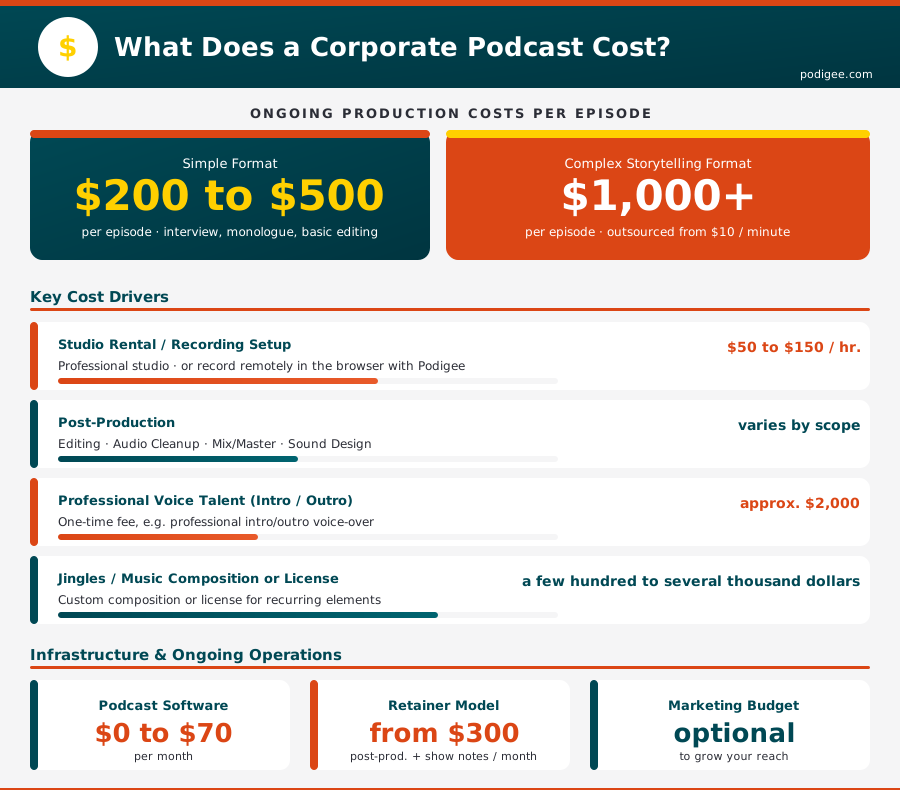
The production costs of a corporate podcast can't be pinned to a fixed amount, because they depend on various factors. These include studio space and technical equipment, fees or compensation for interview guests, licensing and production costs for music and jingles, your choice of podcast platform, and your available marketing budget.
That's why it's common practice to calculate costs per episode within a range and to plan for additional one-time setup costs.
For ongoing production, simple formats typically cost around $200 to $500 per episode. More elaborate storytelling formats can quickly reach four figures per episode. If you outsource production, pricing is often based on the length of the podcast, starting at around $10 per finished minute.
One major cost factor is the recording setup. Professional studios often charge $50 to $150 per hour. For many interview and conversation formats, recording in the browser is enough today: in the Podigee Recording Studio, you record with up to 8 people in full quality, without a studio and without guests having to travel.
On top of that come post-production costs such as editing, audio enhancement, mixing, and mastering, plus optional sound design and recurring elements like intros and outros. For branding purposes, custom jingles or compositions may be produced, with costs ranging from a few hundred to several thousand dollars. Alternatively, you can use licensed music or jingles. A professional voice-over for intros and outros is also an option, typically around $2,000.
Beyond production, corporate podcasts involve infrastructure and operating costs, starting with your podcast platform. With Podigee, you start for free on the LAUNCH plan; paid plans range from €19/month (STARTER) to €59/month (CREATOR), plus VAT where applicable, and Enterprise plans are available on request. Compare all plans on the Podigee pricing page.
Ongoing work around the podcast is often underestimated. Project management, publishing, show notes and assets, distribution, and reporting all require continuous effort. Some service providers offer retainer models, for example post-production including show notes and publishing from around $300 per month. Your platform takes some of this off your plate: Podigee creates transcripts automatically, and one upload publishes to all platforms.
Overall, a realistic budget typically consists of one-time setup costs, recurring production costs per episode, and an optional marketing budget to grow your reach over time.
➔ Tip: Our guide to podcast software and tools shows which tools you actually need for planning, recording, editing, and publishing, and our article on streamlining your podcast production helps you save time on recurring tasks.
Conclusion: Run Your Corporate Podcast on One Platform
A corporate podcast pays off when your goals, audience, and resources are clear. You save the most time when recording, publishing, video, transcripts, repurposing, and analytics come together in one place and your team works there with clear roles. See how communications and marketing departments work with Podigee on our page Podigee for marketing teams.
FAQ: Corporate Podcasts
- What Is a Corporate Podcast?
A corporate podcast is a podcast a company produces for internal communication or as an external marketing tool. Depending on the target audience, it is distributed through private channels such as private podcast feeds or made publicly available. In both cases, it represents the brand and clearly communicates its values and expertise.
- What Is the Difference Between a Corporate Podcast and a Branded Podcast?
The key difference between a corporate podcast and a branded podcast is focus: branded podcasts are entertainment-driven and convey brand values indirectly through storytelling. Corporate podcasts are information-driven and represent the brand openly, communicating values or unique selling points internally or to customers.
Branded podcasts aim to build brand identity and an emotional connection with the audience. They are usually creative and entertaining, often use storytelling, and align closely with the interests of their audience to build a loyal community.
Corporate podcasts, in contrast, are often used for internal communication or official company representation. They cover company news, interviews, or training content, with the goal of fostering transparency, engagement, and trust.
- How Much Does a Corporate Podcast Cost?
A corporate podcast typically costs from a few hundred dollars per episode for simple formats to four figures per episode for elaborate storytelling productions. On top of that come one-time setup costs such as concept, cover design, and intro or jingle, plus ongoing costs for recording, post-production, your podcast platform, and possibly marketing. Recording in the browser instead of a studio saves part of the studio costs.
- How Do You Create a Concept for a Corporate Podcast?
To create a concept for your corporate podcast, start by defining your goals, target audience, and positioning so you have a clear direction and measurable success criteria. Then develop the format, structure, and content plan, and clarify roles, resources, and responsibilities. Finally, define distribution, communication, and suitable KPIs. With a clear plan and ideally a sparring partner, this is very manageable.
- When Is a Corporate Podcast Especially Worth It?
A corporate podcast is especially worth it for your company in two scenarios:
Internal communication:
You are part of a larger organization with multiple locations or a workforce that is hard to reach. Your corporate podcast helps strengthen company culture and share internal updates.External communication:
You want to take your marketing strategy to the next level and increase brand awareness. With a corporate podcast, you share your brand's identity, values, and strengths with a wider audience.In both cases, you need sufficient time, resources, and clearly defined goals. Only then can a corporate podcast deliver real value as a communication and marketing tool.
- How Do You Measure the Success of a Corporate Podcast?
You measure success with KPIs that match your goals. So first be clear about what you want to achieve: more brand awareness, strong audience engagement, or mainly sharing information and knowledge?
Then track the relevant metrics, for example with Podigee Analytics. For brand awareness, growth rate and number of subscribers matter most. Audience engagement shows in ratings and conversion rate. For internal communication, number of downloads and average listening duration per episode tell you whether employees access the content and listen to the end.
- How Do You Record a Corporate Podcast with Guests in Different Locations?
For your corporate podcast the easiest way to record guests in different locations is in the browser, for example in the Podigee Recording Studio. Your guests only need a link, up to 8 people can join for up to 4 hours in audio or video, and every voice is recorded in full quality on its own track. The recording becomes your episode directly. The Recording Studio is included from the Grow plan.
- How Do You Publish a Podcast Only for Employees?
You publish a podcast only for employees through a private, protected feed instead of public platforms. With Podigee Private Podcasts (from the Scale plan), you invite employees by email, even in bulk. Each person gets a personal feed or listens via login in the web player, and you see aggregated analytics.