Enterprise Podcast Production: How to Give Your Company a Voice
Enterprise podcast production is one of the most effective ways to build brand authority, deepen audience relationships, and communicate at scale. Learn how to plan, record, and publish a company podcast, what it costs, and what to look for in a podcast platform.
)
Reading progress
In this article
In this article
Enterprise Podcast Production at a Glance
Definition: An enterprise podcast is produced by a company to reach specific audiences and achieve marketing or communication goals. The most common formats are branded podcasts and corporate podcasts.
Benefits: Enterprise podcasts build brand awareness, trust, and customer loyalty by delivering genuine value rather than traditional advertising. They let companies demonstrate expertise and position their brand for the long term.
Planning and production: A successful enterprise podcast requires clear goals, a defined audience, a consistent format, and structured internal workflows before you ever hit record. During production, audio quality, authentic hosts, professional editing, and a solid distribution strategy are the deciding factors.
Recording: Interviews and panel conversations don't require a studio. With the Podigee Recording Studio, up to 8 people record together in the browser, in audio or video, and the recording becomes your episode directly.
Costs: Enterprise podcast production costs vary widely depending on scope, format, and resources. Simple in-house productions typically run a few hundred dollars per episode; more ambitious formats can reach four figures per episode or more. One-time setup costs and ongoing expenses for recording, post-production, your podcast platform, and marketing come on top.
Platform: An open podcast platform like Podigee brings recording, hosting, distribution, transcripts, content repurposing, and analytics together in one place, with roles for your team and privacy-first infrastructure in Germany and the EU.
What Is an Enterprise Podcast?
An enterprise podcast is a podcast produced by a company to achieve specific communication or marketing goals. You use the podcast format to share content that's relevant to your target audience: industry knowledge, behind-the-scenes perspectives, expert interviews, or thought leadership on topics your audience actually cares about. It works as a classic audio show just as well as a video podcast that also lives on YouTube.
Branded Podcasts vs. Corporate Podcasts
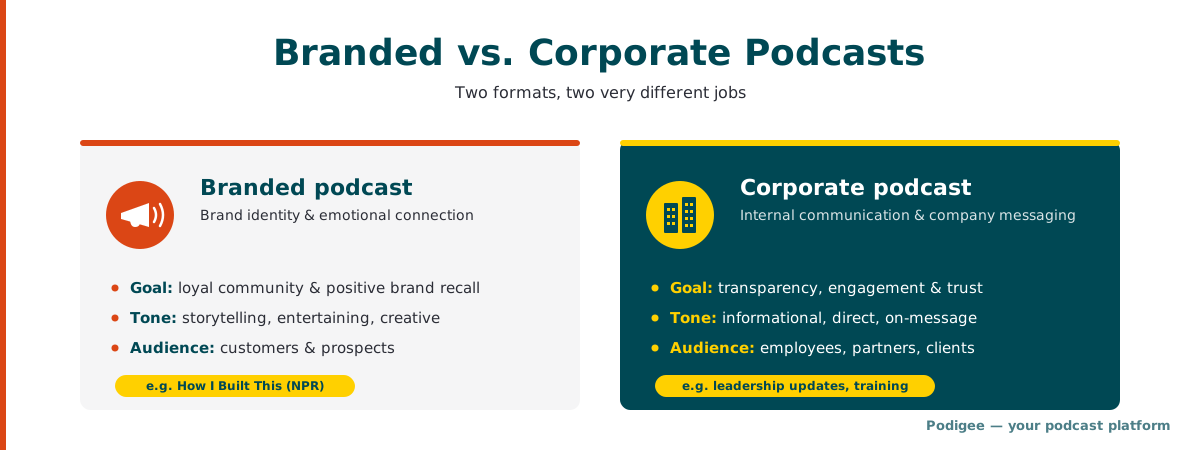
The two most common formats for enterprise podcast production are branded podcasts and corporate podcasts.
Branded podcasts focus on building brand identity and emotional connection. They tend to be creative and entertaining, lean heavily on storytelling, and are shaped around the interests of the target audience. The goal is a loyal community that associates positive feelings with your brand.
Corporate podcasts serve a different purpose: often internal communication or official company messaging. They're more information driven, covering company news, leadership interviews, training content, or policy updates. The goal is transparency, engagement, and trust within an existing audience (employees, partners, clients). If you're planning a show for employees or internal comms, our guide to corporate podcasts goes deeper on that use case.
Podcast Marketing
Enterprise podcasts fit naturally into a company's broader content and brand strategy and are a core part of podcast marketing. They can establish expertise, build trust, reinforce brand positioning, and create lasting relationships with customers and prospects. Unlike traditional advertising, the focus is always on value for the listener. The brand message travels in the background, carried by stories, discussions, and conversations around topics that genuinely matter to your audience. And every episode can feed your blog, newsletter, and social channels too, more on that below.
How to Plan an Enterprise Podcast
Building a concept for an enterprise podcast can feel overwhelming at first. But with a clear framework and a thought partner in the room, the process moves quickly. Use this eight-step guide as your starting point:
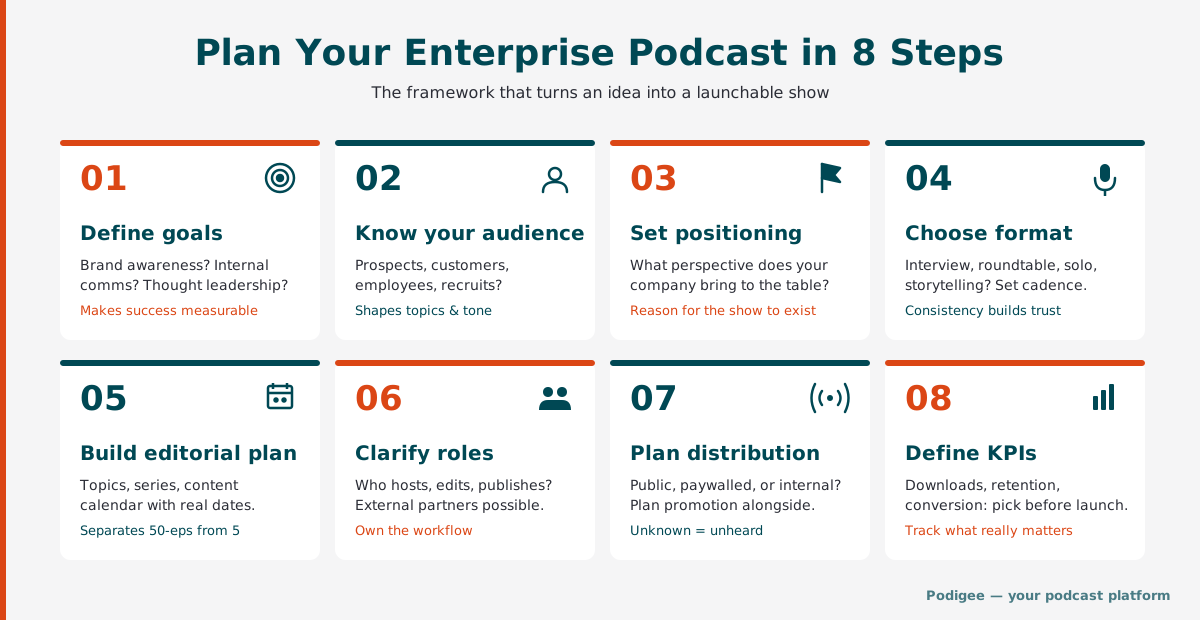
Define your goals
Start by getting crystal clear on what your enterprise podcast is supposed to accomplish. Do you want to increase brand awareness? Communicate with employees? Establish your company as an authority in your space? Concrete goals also make success measurable later.Know your audience
Your podcast should be built around the people you want to reach: prospects, existing customers, employees, recruits, or industry partners. The better you understand your audience, the better you can shape your topics, tone, and episode length.Establish your positioning and core message
What does your podcast stand for? What perspective does your company bring to its industry? A clear positioning makes your podcast recognizable and gives it a reason to exist beyond the company that produces it.Choose your format and structure
Interview show, roundtable, solo commentary, narrative storytelling? Audio only, or a video podcast as well? Once you've picked a format, nail down episode length, release cadence, and any recurring segments. Consistency builds listener trust.Build your editorial plan
Map out topics, organize them into series or thematic clusters, and build a content calendar. A solid editorial plan is what separates shows that publish 50 episodes from shows that abandon ship after five.Clarify roles and resources
Who hosts? Who handles research, editing, approval, and publishing? Be honest about how much time and budget your team can realistically commit. Many enterprise podcasts fail not because the content is bad, but because no one owns the workflow. Consider external partners for production or post-production if internal capacity is limited.Plan your distribution and promotion
Decide whether your podcast will live on public platforms (Spotify, Apple Podcasts, YouTube), behind a paywall, or on internal channels (intranet, Slack, a private feed). Either way, plan how you'll promote it. A podcast no one knows about is just audio files on a server.Define KPIs before you launch
Choose your success metrics before you publish the first episode. Download numbers, listener retention, subscriber growth, conversion rates? Knowing what you're measuring from the start makes optimization much easier down the line.
New to podcasting entirely? Our step-by-step guide to starting a podcast walks you through everything from zero to published.
How to Produce an Enterprise Podcast
Beyond a solid concept, great enterprise podcast production comes down to a handful of non-negotiables. Here's what matters most:
Audio quality
Poor audio is the fastest way to lose a listener. A decent microphone, headphones, and a room with controlled acoustics are the bare minimum, whether you're recording in-house or at a professional studio.
Tip: With the Podigee Recording Studio, you record interviews right in your browser. Guests only need a link, every track is recorded locally in full quality, and the recording becomes your episode directly. More on that in the next section.Authentic hosts
Enterprise podcasts work best when they feel human, not corporate. Your host should be able to hold a real conversation, take the subject seriously, and make the listener feel like they're in the room.Professional editing and sound design
Clean editing keeps the episode flowing. A consistent intro, outro, and sound identity builds recognition across episodes. Don't underestimate how much this contributes to perceived quality.Structured workflows and clear ownership
Most enterprise podcasts don't fail because the content is weak. They fail because no one built a reliable process. You need defined workflows for topic development, recording, approval, and publishing, with real deadlines attached to each step. In Podigee, you assign roles per podcast (Viewer, Contributor, Admin), so it's always clear who edits, approves, and publishes, and no one has to share passwords.
Tip: Work from a content calendar with fixed publishing dates and clearly owned tasks. Routine work like scheduling episodes or updating show notes across many episodes at once can run through the Podigee MCP Server with AI assistants like Claude or ChatGPT, with a preview before every change.Distribution done right
A podcast only creates value if people can actually find and listen to it, whether that's on public platforms or through internal channels. An open podcast platform like Podigee does much of the heavy lifting here, from recording to publishing on 15+ platforms to reporting. A strong cover image and well-crafted show notes matter more than most people expect.
Tip: See how to distribute your podcast to every major platform with one upload.Gather feedback and improve
For enterprise podcasts especially, feedback is gold. Internally, use surveys. Externally, watch your reviews, social mentions, and listener messages. Understanding what your audience wants helps you sharpen the show over time.
Tip: Podigee Analytics gives you the data to identify what's working and what needs work.
Record Without a Studio: The Podigee Recording Studio
Many enterprise podcasts are built on conversations: with customers, subject matter experts from inside the company, or guests from across the industry. Instead of booking a studio and getting everyone into one room, you record with the Podigee Recording Studio directly in Podigee, in the browser, solo or with guests. Guests join via a link or email invite, with no software to install and no account to create.
Up to 8 people, up to 4 hours: enough for interviews, roundtables, and expert panels, as an audio or a video podcast.
Full quality as a double-ender: Every voice is recorded locally on each participant's device and lands on its own track. Uploads run during the conversation and resume where they left off if the connection drops.
Less post-production: Podigee aligns the tracks automatically and levels the volume. For video, it creates a combined video of all participants automatically.
Built-in editor: waveform view, trimming, mute and solo, fine alignment. Download individual tracks whenever your agency or editor needs them.
The recording becomes the episode: no export, no re-upload. From there, you publish straight to Spotify, Apple Podcasts, YouTube, and more.
The Recording Studio is included starting with the Grow plan (€29/month). Explore everything the Podigee Recording Studio can do
What Does Enterprise Podcast Production Cost?
There's no single number that answers this, because enterprise podcast production costs depend on a wide range of factors: recording setup and equipment, guest fees, music licensing, editing and post-production, your podcast platform, and marketing budget.
The most practical way to think about it is in two buckets: one-time setup costs and per-episode production costs.
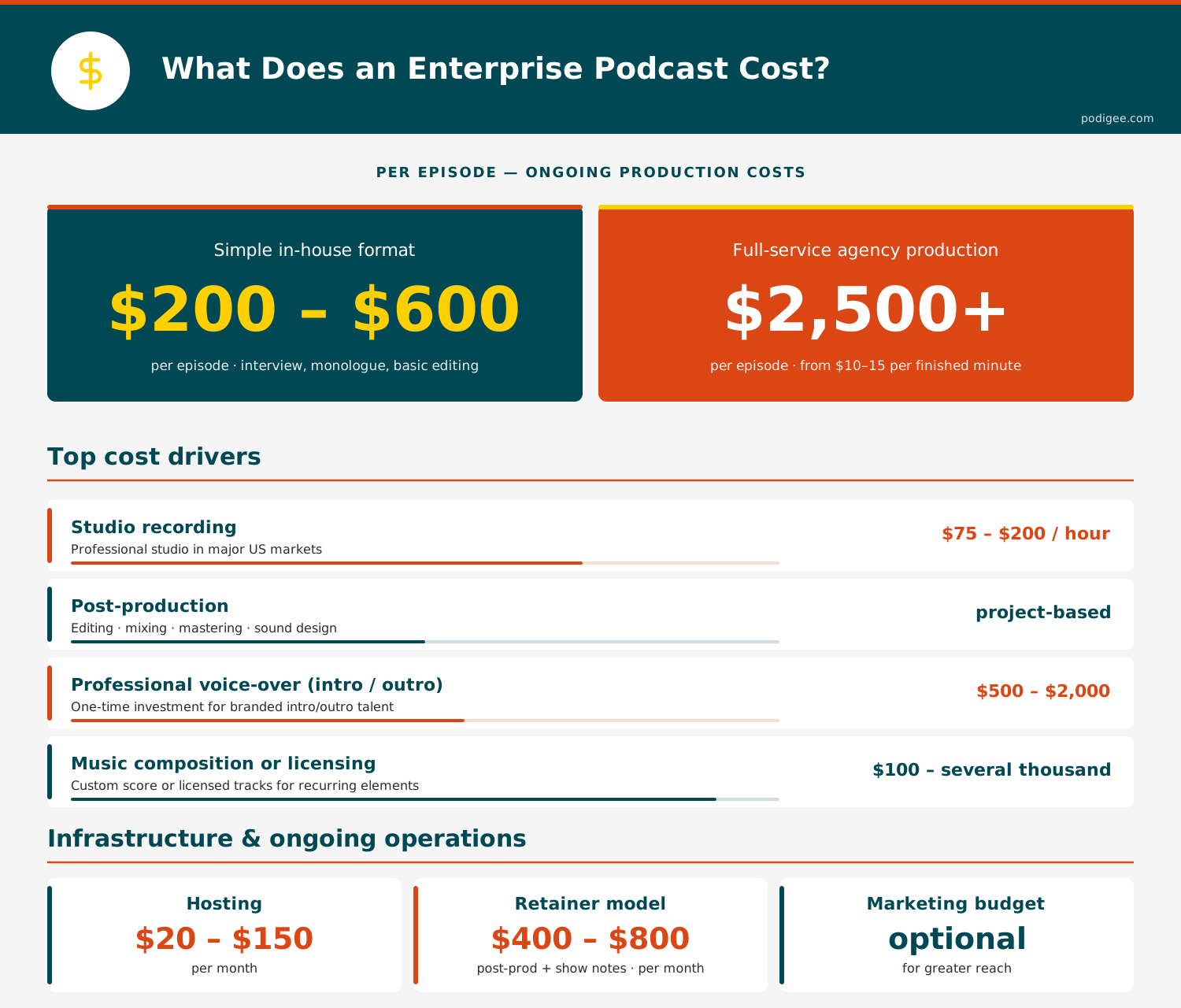
Per-Episode Production Costs
Production model | Estimated cost per episode |
|---|---|
Simple in-house format | $200 to $600 |
Partial external production | $600 to $2,500 |
Full-service agency production | $2,500 to $6,000+ |
For external production, many agencies price by finished minute of audio, with rates typically starting around $10 to $15 per finished minute.
Key Cost Drivers
Studio recording: Recording in a professional studio typically runs $75 to $200 per hour in most US markets. For remote interviews with up to 8 people, you can skip the studio: the Podigee Recording Studio is included starting with the Grow plan, and your guests never have to travel. If you're recording in-house, microphone and acoustic treatment costs are a one-time investment.
Post-production: Editing, mixing, mastering, and noise removal per episode. This can be done internally or outsourced.
Sound design and branding: Custom intro and outro music, jingles, and voice-over talent. A professional custom composition can range from a few hundred to several thousand dollars. Professional voice-over talent for a branded intro and outro typically runs $500 to $2,000.
Podcast platform: With Podigee, you start for free on the LAUNCH plan; paid plans range from €19/month (STARTER) to €59/month (CREATOR). Dynamic ad insertion, private podcasts, and 3 team seats come with SCALE (€39/month), and Enterprise plans for larger teams and multiple shows are available on request. Compare everything on the Podigee pricing page.
Ongoing operational overhead: Show notes, asset creation, scheduling, publishing, and reporting take real time every episode. Some production agencies offer retainer packages covering post-production plus publishing for $400 to $800 per month. Your platform can take part of this off your plate: in Podigee, transcripts and show note drafts are created automatically, and audio and video go out to every platform with one upload.
The total annual investment for a consistent enterprise podcast (one episode every two weeks) might range from around $15,000 for a well-run in-house production to $100,000 or more for a full-service branded content show. Most enterprise teams land somewhere in between.
Enterprise Podcast Hosting and Publishing: What You Need to Know
The technical process of publishing an enterprise podcast works like any other podcast:
Upload or record: You upload your audio or video file to your podcast platform. If you record in the Podigee Recording Studio, this step disappears, because the recording becomes the episode.
Processing: The platform stores your files and generates an RSS feed, a machine-readable file at a permanent URL.
Distribution: The feed is submitted to Spotify, Apple Podcasts, Amazon Music, and other platforms. With Podigee, audio and video go to YouTube, Spotify, and Apple Podcasts with one upload.
Reporting: The platform shows you how your audience engages with each episode.
But enterprise teams have additional requirements that go well beyond what a basic consumer hosting plan provides.
A note on self-hosting: You can technically host your podcast on your own servers without a platform. In practice, this means significant technical overhead, ongoing maintenance, and high error risk. Podigee is the open podcast software for hosting, recording, video, transcription, analytics, and monetization, so your team can focus on content, not infrastructure.
What Matters Specifically in Enterprise Podcast Hosting
Ownership and control: Your company should own the RSS feed and all platform accounts, even if you work with an external production agency. Full data and brand ownership means you're never locked out of your own show. With roles and permissions per podcast, your agency, editorial team, and approvers work in the same account. SCALE includes 3 users, CREATOR includes 5.
Reliable analytics: Enterprise teams need IAB-compliant statistics and advanced tracking to measure campaigns, reach, and marketing ROI. Vanity metrics aren't enough. Tip: Podigee Analytics is IAB v2.2 certified and includes episode and show comparisons, CSV export, weekly email reports, and the Podigee app for iOS and Android.
Dynamic Ad Insertion (DAI): DAI lets you swap or insert campaign messages and ads into your episodes after publishing, including older ones. This enables flexible, time-sensitive, or audience-targeted communication at scale. Tip: With dynamic ad insertion from the SCALE plan, you run your own sponsors and messages right inside Podigee. Learn more about podcast monetization with Podigee.
Private and internal podcasts: For internal communications (employee updates, training content, leadership messages), you need private feeds that aren't publicly discoverable. Tip: With Podigee private podcasts, you invite listeners by email, individually or in bulk. Every person gets a personal feed or listens via web player login, Spotify Open Access is supported, and you see aggregated analytics. Private podcasts are included from the SCALE plan.
Video and content repurposing: One conversation, many assets. With one upload, you publish audio and video to YouTube, Spotify, and Apple Podcasts. The Text Composer turns each episode into drafts for LinkedIn posts, newsletters, and SEO articles, and the Clipper suggests up to 5 clip moments per episode in 9:16, 1:1, or 16:9. Tip: See how video podcasts on YouTube, Spotify, and Apple Podcasts work and how repurposing tools like Text Composer and Clipper get more out of every episode.
Website integration and SEO: An embeddable web player, optimized show notes, and transcripts all help your podcast contribute to your website's SEO performance and discoverability. Your podcast should be part of your content strategy, not separate from it. Tip: Podigee creates automatic AI transcripts with a custom dictionary for industry terms that appear in the player, on the episode page, and in the feed, plus a podcast website and embeddable player. Our podcast SEO guide covers the practical steps to make your audio content rank.
Data privacy and compliance: Enterprise organizations need to handle listener data responsibly. Look for a platform with a clear data processing agreement, transparent data storage, and privacy-friendly analytics. Podigee runs on servers in Germany and the EU, is built for GDPR, offers a data processing agreement right in your account, and comes with a cookie-free player that doesn't track your listeners. That's a privacy benefit your legal team and your audience will both appreciate.
Conclusion: Run Your Enterprise Podcast on One Platform
An enterprise podcast pays off when goals, audience, and resources are clear. You save the most time when recording, publishing, video, transcripts, repurposing, and analytics come together in one place and your team works in it with clear roles. Running several shows? Enterprise, Broadcaster, and Network plans with portfolio management and portfolio analytics are available on request. See how communications and marketing teams work with Podigee on our page for Podigee for marketing teams.
FAQ: Enterprise Podcast Production
- What is an enterprise podcast?
An enterprise podcast is a podcast produced by a company to communicate with specific audiences. The most common formats are branded podcasts and corporate podcasts. Rather than relying on traditional advertising, enterprise podcasts use content, storytelling, and expertise to share knowledge, demonstrate authority, and develop long-term relationships with listeners. The goal is typically to position the company as a trusted voice in its industry.
- Who is an enterprise podcast for?
Enterprise podcasts are aimed at clearly defined audiences: existing customers, prospective customers, employees, job candidates, or industry partners. Some enterprise shows focus on just one of these groups; others serve multiple audiences across separate series or feeds. For internal audiences, a private feed that only invited listeners can access works best.
- Why should my company start a podcast?
Your company should start a podcast because podcasting is a high-attention medium with a loyal audience. For enterprise organizations, the advantages include:
Deep engagement: Podcasts are usually listened to intentionally and for long stretches at a time.
Personal connection: A recognizable voice builds familiarity and trust faster than most written content.
Thought leadership: Your company can demonstrate expertise and point of view in your industry.
Content marketing leverage: Every episode can fuel blog posts, social clips, newsletters, and more, for example with Podigee's Text Composer, Clipper, and Quote Finder.
Competitive differentiation: A well-executed enterprise podcast is still relatively rare. Done right, it separates you from competitors who are only publishing articles.
- Do I need an agency for enterprise podcast production?
No, you don't necessarily need an agency for enterprise podcast production. Many enterprise teams run strong in-house productions with the right tools and workflows. An agency makes the most sense when your team lacks internal bandwidth or production experience, or when the format requires a level of production quality that's hard to achieve without specialized expertise.
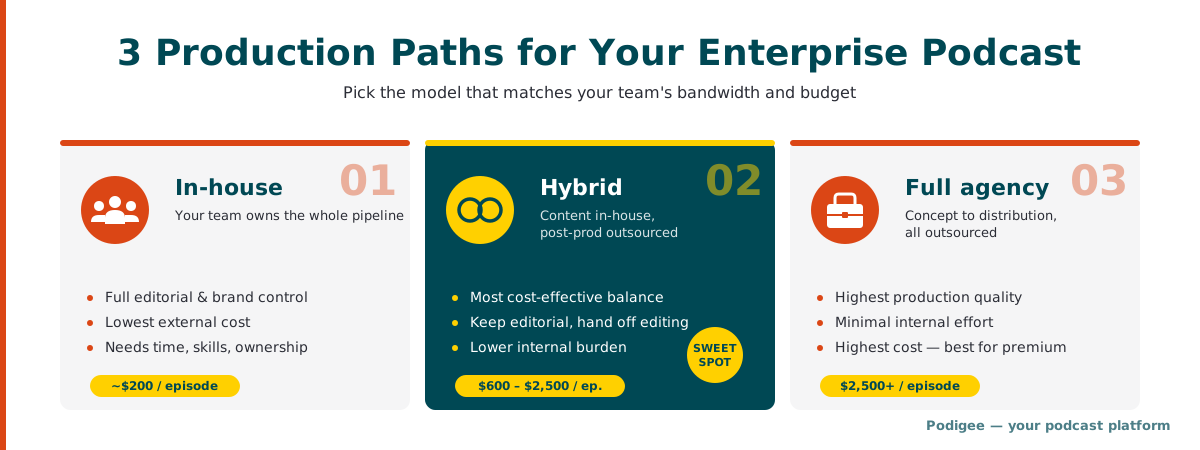
There are essentially three paths:
1. In-house production: Your team handles everything from concept to distribution. This requires time, technical skills, and internal editorial resources. A platform where recording, publishing, and reporting come together cuts the workload significantly.
2. Agency production: A specialized podcast production agency handles concept, recording, editing, distribution, and marketing. Higher cost, lower internal burden.
3. Hybrid model: Many enterprise teams develop content and host interviews internally, while outsourcing post-production (editing, mastering, show notes, publishing) to an external partner. This is often the most cost-effective balance. With roles and permissions in Podigee, the agency works directly in your company's account.
- How much does an enterprise podcast cost?
An enterprise podcast typically costs anywhere from a few hundred dollars per episode for simple in-house formats to four figures or more per episode for ambitious storytelling produced with external partners. On top of that come one-time setup costs (concept, cover art, intro or jingle) and ongoing costs for recording, post-production, your podcast platform, and promotion.
Simple in-house format: about $200 to $600 per episode
Partial external production: about $600 to $2,500 per episode
Full-service agency production: about $2,500 to $6,000 or more per episode
- Do I need a recording studio for an enterprise podcast?
No, for an enterprise podcast, most interview and conversation formats don't need a recording studio. With the Podigee Recording Studio, up to 8 people record together in the browser for up to 4 hours, in audio or video. Every voice is recorded locally in full quality on its own track, and the recording becomes your episode directly. The Recording Studio is included starting with the Grow plan. A good microphone and a quiet room still make a big difference.