
How to Promote a Podcast: 10 Ways to Grow Your Audience
How to promote a podcast and grow your audience: 10 strategies from the basics and podcast SEO to guesting, cross-promotion, and TikTok clips that actually turn views into listeners – plus the metrics that show what works.


Reading progress
In this article
In this article
If you want to know how to promote a podcast, start with this: new listeners only reach your show in three ways. They find it through search and podcast apps, someone recommends it, or they come through your own channels. The audience is there – according to Edison Research's The Podcast Consumer 2025, 55% of Americans aged 12+ have listened to a podcast in the last month.
Key Facts: How to Promote a Podcast
Podcast growth comes from discoverability (directories, SEO), recommendations (guests, cross-promotion, word of mouth), and your own channels (website, newsletter, social media).
Before you spend money on ads, get the basics right: title, description, category, cover art, and a podcast website.
Guests with their own audience and cross-promotion with similar shows are among the fastest ways to grow a podcast audience.
Short-form clips bring views, but only a clear call to action, a direct link, and a reason to keep listening turn them into podcast listeners.
You can promote a podcast for free – paid promotion only makes sense once you know which channels work.
Track every tactic in your podcast analytics so you know what actually grows your show.
How Podcast Growth Works
Your podcast reach is the number of people who actually listen to your episodes. Podcast apps rarely push unknown shows to new people the way social feeds do. Listeners have to discover your podcast actively – through search, a recommendation, or a link. That's why recommendations matter so much: in the US study Podcast Discovery Playbook 2026 by Sounds Profitable, 64% of listeners say they receive podcast recommendations from friends, and 72% of them are likely to act on those recommendations.
The same study shows where people discover their favorite shows: YouTube accounts for 40% of favorite-show discovery among US podcast listeners, followed by Facebook (17%), TikTok (15%), and Instagram (14%). The strategies below cover every one of these paths.
1. Get the Basics Right: Title, Description, Category, and Cover
Before you promote your podcast, make sure the foundation works. New listeners decide in seconds – based on your cover, title, and description – whether to press play.
Show title: short, memorable, and ideally containing the topic your audience searches for.
Description: say in the first sentences who the show is for and what listeners get out of it.
Category: pick the category your audience browses, not just the biggest one.
Cover art: readable even at thumbnail size on a phone.
Episode titles: name the concrete topic of the episode instead of "Episode 42".
More directories mean more entry points. Besides Apple Podcasts and Spotify, publish on YouTube, Amazon Music, and other podcast apps. With Podigee's podcast hosting and distribution, one RSS feed delivers your episodes to all major platforms.
2. Build a Podcast Website as Your Home Base
Social profiles, newsletters, and guests all need one place to link to. A podcast website with a web player and subscribe buttons is that home base: people can listen right away and follow the show in their favorite app without searching. With the Podigee podcast website and player, you get both without building your own site.
3. Use Podcast SEO to Get Discovered
Many people don't search for a podcast name but for a topic. When your episode titles, descriptions, and show notes name those topics, you're more likely to be found in podcast apps, on Google, and in AI assistants. Transcripts give search engines the full content of your episode as text. Podigee creates a transcript automatically after upload – learn more about transcripts, chapters, and show notes.
4. Podcast Guesting: Grow Your Podcast Audience Through Other Shows
The fastest way to grow a podcast audience is to borrow other people's reach. Podcast guesting works in two directions:
Invite guests: a guest with their own community will share the episode with their followers. Make it easy and send a small kit after release with the link, a clip, and a quote graphic.
Be a guest: appear on shows whose listeners match your audience, and say clearly at the end where people can find your own podcast.
Fit beats size: a smaller show with exactly your audience often brings more listeners than a big show whose audience doesn't care about your topic.
5. Podcast Cross-Promotion With Other Shows
In podcast cross-promotion, two shows recommend each other – with a short trailer swap or a personal shout-out in an episode. It works because the recommendation reaches people who already listen to podcasts. Look for partners with a similar audience but not an identical topic, and agree on when and how often you mention each other.
6. Promote Your Podcast for Free With Email and Your Network
Your own channels belong to you – unlike reach on social platforms. That makes them the best way to promote a podcast for free:
Newsletter: announce every new episode with one sentence on the benefit and a direct link.
Email signature: a link to your podcast website in every email costs nothing.
Personal network: ask friends, colleagues, and customers to recommend one specific episode to someone it would help.
Company channels: for corporate podcasts, add the website, intranet, and sales team to your distribution list.
7. Build a Community and Involve Your Listeners
Listeners who feel part of your show recommend it. Answer listener questions on air, ask for topic ideas, and use platform features like Q&A and polls on Spotify. Ask for ratings and reviews with a concrete sentence at the end of each episode ("If this episode helped you, leave us a quick rating in your app") – it works better than a vague reminder.
8. How to Promote a Podcast on Social Media
To promote a podcast on social media, don't think "I'll post the link to the new episode". Think in content that works on the platform itself: the best moments of each episode become standalone posts. A simple podcast social media strategy looks like this:
Platform | Format | What to focus on |
|---|---|---|
Reels, Stories, carousels | Link in bio and in Stories, always add captions | |
TikTok | Short vertical clips | Strong first seconds, clear prompt to keep listening |
YouTube | Full episodes and Shorts | Point Shorts to the full episode, use chapters |
Text posts, clips, quotes | One key point per post | |
Posts for new episodes | Post new episodes automatically with Podigee |
For brand and company podcasts, you'll find more strategies in our guide to podcast marketing. And if you stream, see how podcasters can use Twitch to grow their audience.
9. Podcast Clips on TikTok and Reels: Why Views Don't Become Listeners
Many podcasters know this problem: a clip gets tens of thousands of views, but episode downloads barely move. The reason is simple – a clip is made for the platform, not for switching to a podcast app. People scrolling want to keep scrolling. To turn TikTok and Reels viewers into podcast listeners, you need a bridge.
It's worth building: among listeners who found a show through social media, 60% came from an organic post by an account they follow, according to the Sounds Profitable study.
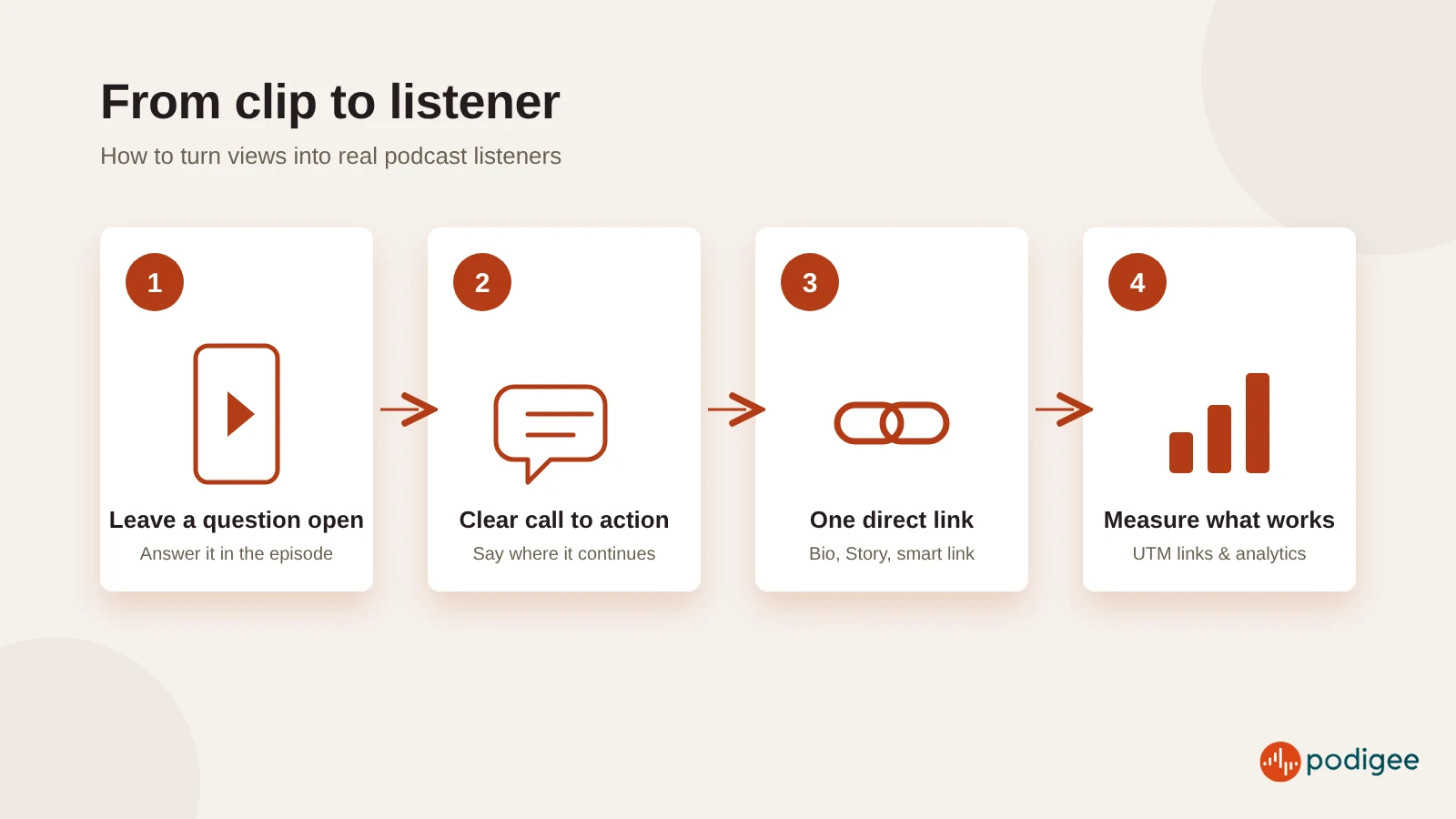
How to Turn Podcast Clips Into Listeners
Leave a question open: show the question or the conflict in the clip – the answer is in the episode.
Clear call to action: say it and show it on screen, e.g. "Full episode: link in bio".
One link that works everywhere: link to your podcast website or a smart link that opens the listener's favorite app. On TikTok, business accounts can add a website link to their profile, according to TikTok's help center.
Make it measurable: use a separate link with UTM parameters per channel to see in your website analytics which platform actually sends visitors.
Meet video viewers on video: people who prefer watching are best sent to the full episode on YouTube, not to an audio app.
You don't have to edit every clip by hand: the Clipper in Podigee's repurposing tools suggests up to five strong moments per episode and exports them in 9:16, 1:1, or 16:9. Audio-only episodes become audiograms with your cover and an animated waveform.
10. Publish Consistently and Stay Patient
Podcast growth builds with every episode, because each one creates new entry points. A fixed release schedule – weekly or every two weeks – makes you reliable for listeners. Batch-record episodes and schedule them in advance so vacations or busy weeks don't leave gaps. And give every tactic time: a podcast audience grows over months, not days.
Measure Your Podcast Growth: The Metrics That Matter
Without measurement you won't know which tactic grows your podcast. Check these metrics regularly:
Metric | What it tells you |
|---|---|
Downloads per episode | How many people get each episode – the basis of every growth analysis |
Performance over the first days | How strongly an episode launches and whether promotion causes spikes |
Platforms and apps | Where your listeners are and which platform deserves more attention |
Website visitors by source | Which social channels and links bring listeners (UTM parameters) |
Podigee Analytics shows downloads, platforms, and apps in one place, measured according to the IAB standard. For a deeper look at the numbers, read our guide to podcast analytics.
Conclusion: Grow Your Podcast With a System
Promoting a podcast is a marathon: get the basics right, earn recommendations through guests and cross-promotion, use your own channels, and build social clips that lead people to the full episode. Measure what works and double down on what brings you more listeners.
Ready to grow your audience? With Podigee you host your podcast, distribute it to every major platform, create clips, and track your growth in one place.
FAQ: How to Promote a Podcast
- How do I promote my podcast?
You promote your podcast by publishing it on all major platforms, optimizing titles and descriptions for search, using guests and cross-promotion for recommendations, and linking social clips to your episodes with a clear call to action. Then check in your analytics which tactics actually bring listeners.
- How do I grow a podcast audience from zero?
To grow a podcast audience from zero, borrow other people's reach: invite guests with their own community, appear as a guest on shows with a similar audience, and ask your personal network for targeted recommendations. At the same time, podcast SEO makes sure people find you through topics.
- How can I promote my podcast for free?
You can promote your podcast for free through your own channels and other people's audiences: a newsletter, your email signature, social media clips, guest appearances, cross-promotion swaps, and community features like Q&A and polls. None of these require an ad budget.
- How do I get more podcast listeners from social media?
You get more podcast listeners from social media with content that works on the platform: short clips with captions, quotes, and behind-the-scenes posts. Every post needs a clear hint where the full episode is and a direct link in your bio or Story.
- Why are my TikTok views not turning into podcast listeners?
TikTok views often don't turn into podcast listeners because the clip is self-contained and viewers have neither a reason nor an easy way to switch apps. Leave a question open in the clip, say exactly where the episode continues, and put a link in your bio that leads straight to it.
- How long does it take to grow a podcast?
How long it takes to grow a podcast depends on your topic, release schedule, and promotion. Think in months rather than weeks: every episode creates new entry points, and recommendations, search rankings, and partnerships compound over time.
- How much does it cost to promote a podcast?
Promoting a podcast can cost nothing if you rely on organic tactics like guesting, cross-promotion, SEO, social clips, and email. Paid promotion such as ads in podcast apps or on social platforms has no fixed price – start with a small test budget and only scale what your analytics show is working.