Podcast Downloads vs. Spotify Plays vs. YouTube Views: Why They Don't Add Up
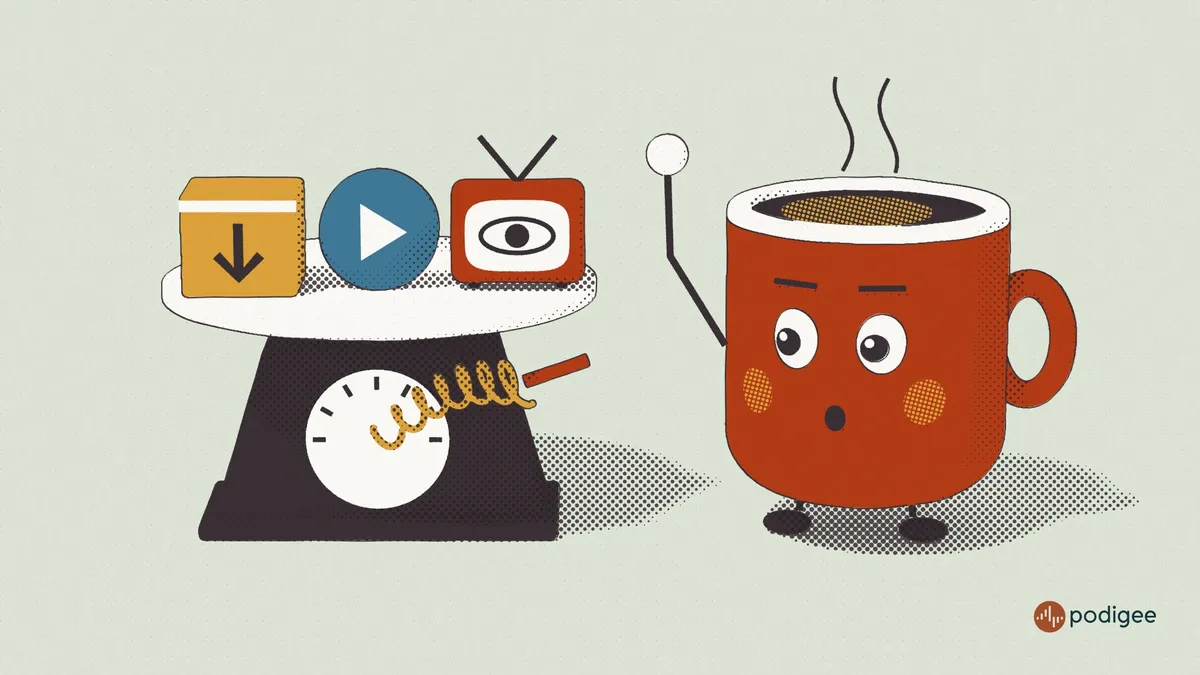
A download is a delivered file, a Spotify play is at least 30 seconds, and a YouTube view starts at the first frame. Two of the three rules changed in 2026. Here is what each number counts and how to report them without adding them up.
Reading progress
In this article
In this article
Podcast downloads, Spotify plays, and YouTube views don't add up because each one counts a different event. Under IAB Tech Lab's guidelines (v2.3, September 2026), a download is at least one minute of an episode delivered to a device. A Spotify play has meant at least 30 seconds of listening or watching since June 11, 2026, and a YouTube view has counted from the first frame since August 24, 2026, with estimated TV co-viewers in public counts since November 16, 2026. Give each number its own row, compare it with its own past, and leave the total out.
What counts as a download, a play, and a view in 2026?
As of November 2026, each platform uses its own threshold for a single count, from one delivered minute for a podcast download to a single frame for a YouTube view. An Apple Podcasts play counts when somebody presses play and gets past zero seconds. Podcast apps fetch episodes through an RSS feed, the file that lists a show's episodes, while Spotify, Apple Podcasts, and YouTube count playback in their own players. Here is what counts as one unit on each, linked to the owner's definition.
Unit | What counts as one | Since when |
|---|---|---|
Podcast download (IAB Tech Lab) | Enough of an episode delivered to play for one minute, after bots and repeats are filtered | v2.0 (December 2017); now in v2.3 (September 2026) |
Spotify play | At least 30 seconds listened or watched | June 11, 2026 |
Spotify stream | 60 seconds or more | No start date given |
Apple Podcasts play | Somebody pressed play and got past zero seconds | No start date given |
Apple Podcasts engaged listener | A person who heard or watched at least 20 minutes or 40% of an episode | No start date given |
YouTube view | The first frame plays, autoplay included, plus estimated co-viewers on TV screens | August 24, 2026; co-viewers November 16, 2026 |
YouTube engaged view | A click to watch, or watching past the initial seconds; no co-viewers | Named August 24, 2026 |
A play or a stream says nothing about what happened after its threshold, and YouTube gives no number of seconds for its engaged view.
Does a podcast download mean somebody listened?
No. A download means that an episode reached a device. IAB Tech Lab's guidelines (v2.3, September 2026) say that a file being played and a file being saved for later look the same in the server logs, and that the difference "can typically only be discerned by the player."
Picture a phone charging on a nightstand. Its owner follows your show on Apple Podcasts, where automatic downloads are on by default and run while the device charges on Wi-Fi. The new episode can arrive, and count as a download, before she's awake.
Downloads can still be the main row for an audio show, because they cover many apps under one published guideline; our guide to podcast analytics shows where to find them. For listening, look where the player can see it: Apple's engaged listeners, or Spotify's completion rate, the share of people who made it through at least 95% of an episode.
Why are my Spotify plays different from my downloads?
Spotify counts seconds of playback inside its own app, while downloads are counted on the server that delivers the file. Spotify has two thresholds: a play needs at least 30 seconds, and a stream needs 60 seconds or more and decides eligibility and revenue in the Spotify Partner Program. Listen for 40 seconds and Spotify logs a play (under its June 11, 2026 rule), while your stream count stays at zero.
The two counts can also overlap, because one person can appear in both. Spotify's help page says other platforms "operate on downloads, while Spotify operates on plays," and the Podigee docs spell out what that means for a total: "A sum of all sources counts some people twice and mixes units." Two totals can't show how many people they share, so if somebody wants to add or subtract them, take the calculator away.
What changed in YouTube view counts in 2026?
YouTube changed its view count twice in 2026, and both changes raise the count: since August 24 a view counts from the first frame, and since November 16 public counts include estimated co-viewers on TV. The first-frame rule covers podcasts too. Hovering over a thumbnail until it autoplays is enough. The older, stricter definition lives on as the engaged view, which requires a click or watching past the initial seconds.
A co-view is YouTube's estimate of an extra person watching on the same TV. Watch time now includes co-views too. Engaged views leave co-views out, so I would put engaged views first and the public number beside them. That way, nobody opens your YouTube page and wonders why your report looks lower.
Can I add downloads, plays, and views into one total reach?
You can, but the sum of downloads, plays, and views won't tell you how many people you reached: it mixes units and can count one person several times. Follow one listener through a Tuesday. Overnight, her phone auto-downloads your new episode while charging: one download. At lunch, she scrolls past your video thumbnail in her YouTube feed and it autoplays for two seconds: one view. In the afternoon, a colleague sends her a Spotify link and she listens for 40 seconds to hear the quote they mentioned: one play. Your combined total says three, from one person who never made it through a single minute.
A total can also jump because somebody rewrote a rule. Say a show had 2,300 downloads, 610 Spotify plays, and 3,100 public YouTube views in October 2026, and 2,240, 640, and 4,000 in November 2026. The total climbs 14%, from 6,010 to 6,880. Behind it, downloads fell by 60, Spotify rose by 30, and YouTube added 900 in the month co-views entered the public count. If engaged views stayed flat, look to the co-view estimate before you celebrate. I'd rather defend three small rows than one big number.
Some dashboards show a combined figure. Spotify's analytics glossary defines a blended "Plays & downloads" metric that mixes 30 seconds of playback on Spotify with downloads on any platform. If a tool hands you one like that, put the definition beside it so nobody mistakes it for unique listeners.
Numbers you can explain in the room.
Podigee is IAB Tech Lab certified (Podcast Measurement Guidelines v2.2). For video shows, Spotify and YouTube numbers stay separate from your downloads, with no blended total.
How do I report a podcast to my boss, client, or sponsor?
Put one line about what a listener did at the very top of the report (a prospect replying to an episode with a question, or twelve people using a link you read out), followed by one row per source, each compared with its own past. For a boss funding a company show, that line matters more than any traffic row. Below it, give every source its own row and include the unit in the label: "Spotify plays (30 seconds)" is clear on its own, while "Spotify" just raises questions.
The comparison works over equal periods, or over the same number of days since release. Mark when a rule changed, too: put June 11, 2026 next to Spotify plays, and August 24 and November 16, 2026 next to YouTube views. July 2026 is the first full month under Spotify's 30-second rule, and December 2026 is the first with both of YouTube's changes. Drop any row you can't explain in one sentence. If you're reporting to a sponsor, spell out which unit the price is based on, because IAB Tech Lab warns that a server-measured ad delivery isn't always an ad exposure confirmed in the player.
How does Podigee show downloads, plays, and views?
Podigee is the publishing platform for audio and video podcasts. Our analytics show each source separately, in its own unit, with no combined total reach. For audio, Podigee counts complete downloads and is IAB Tech Lab certified (Podcast Measurement Guidelines v2.2), and our certification page links to the public report. The docs define the unit as "One complete download of an audio file, counted to the IAB guidelines." A Podigee video play is a session that loaded at least ten segments of the video stream.
For video shows published through Podigee where we've enabled external platform data, Spotify and YouTube figures sit next to your download counts. In Podigee, Spotify figures start on June 11, 2026 at the earliest, the day Spotify redefined a play, so the two definitions never mix. New Spotify figures arrive about a day late, YouTube's two to five, and both can change the last 14 days.
On SCALE and above, you can export analytics as CSV and put the downloads of up to ten shows side by side. The account owner can also get a weekly email report with a PDF and a CSV for each show, so nobody has to pull numbers by hand on Monday morning. Podigee is for people who make shows other people count on.
What should I do before the next report?
Open last month's report and add the exact unit beside every number, along with the 2026 rule dates on your Spotify and YouTube rows. Delete any combined total, and put one plain sentence at the top about what a listener did.
Mateusz "Mati" Sójka is the founder and CEO of Podigee, the publishing platform for audio and video podcasts.
Last week's podcast numbers, ready to share.
Every week, the account owner gets an email with a PDF and a CSV for each show: downloads, week-over-week change, new episodes, and the top five. Included with SCALE and up. Running several shows? Tell us about them.
Frequently asked questions
- What is the difference between a podcast download and a listener?
A download counts one delivered episode, while a listener figure estimates how many people are behind the downloads. In IAB Tech Lab's v2.3 guidelines (September 2026), a "podcast consumer" (its newer term for listener) is estimated by pairing an IP address with a user agent, the identifier an app or browser sends, over a set window. Phones change IP addresses, so one person can count twice and two can be merged.
- Why do two hosting providers show different download numbers for the same show?
Providers can follow the same guidelines and treat repeat requests differently. IAB Tech Lab's v2.3 guidelines (September 2026) allow three measurement windows: a fixed calendar day, 24 hours from the first request, or a window that restarts with each request. Depending on which window a provider picks, the same four requests can count as two or three downloads. Providers can also use alternatives the guidelines allow, such as counting only complete file downloads, so ask each one how it counts.
- Why did my YouTube views go up in November 2026?
On November 16, 2026, YouTube began adding estimated co-views on TV screens to public view counts, so one playback on a shared TV can count as more than one view. To see whether your audience grew, check engaged views, which count no estimated extra people.
- Do YouTube's new view counts change what a channel earns?
No, according to YouTube. As of November 2026, YouTube's help page says adding TV co-views doesn't change YouTube Partner Program earnings or eligibility. Earnings still depend on engaged views and engaged watch hours, while eligibility relies on what YouTube calls "qualified views." A channel's public views can climb while its payout stays flat.
- Will there be one standard metric for audio and video podcasts?
Not yet. On September 29, 2026, IAB Tech Lab said it plans version 3.0 of its podcast guidelines, with a draft for public comment in mid-2027, and expects it to move beyond downloads toward playback. Spotify said on June 11, 2026 that its data helped inform a Podcast Plays definition by the Alliance for Measurement in Podcasting. Until platforms share one unit, keep them in separate rows.